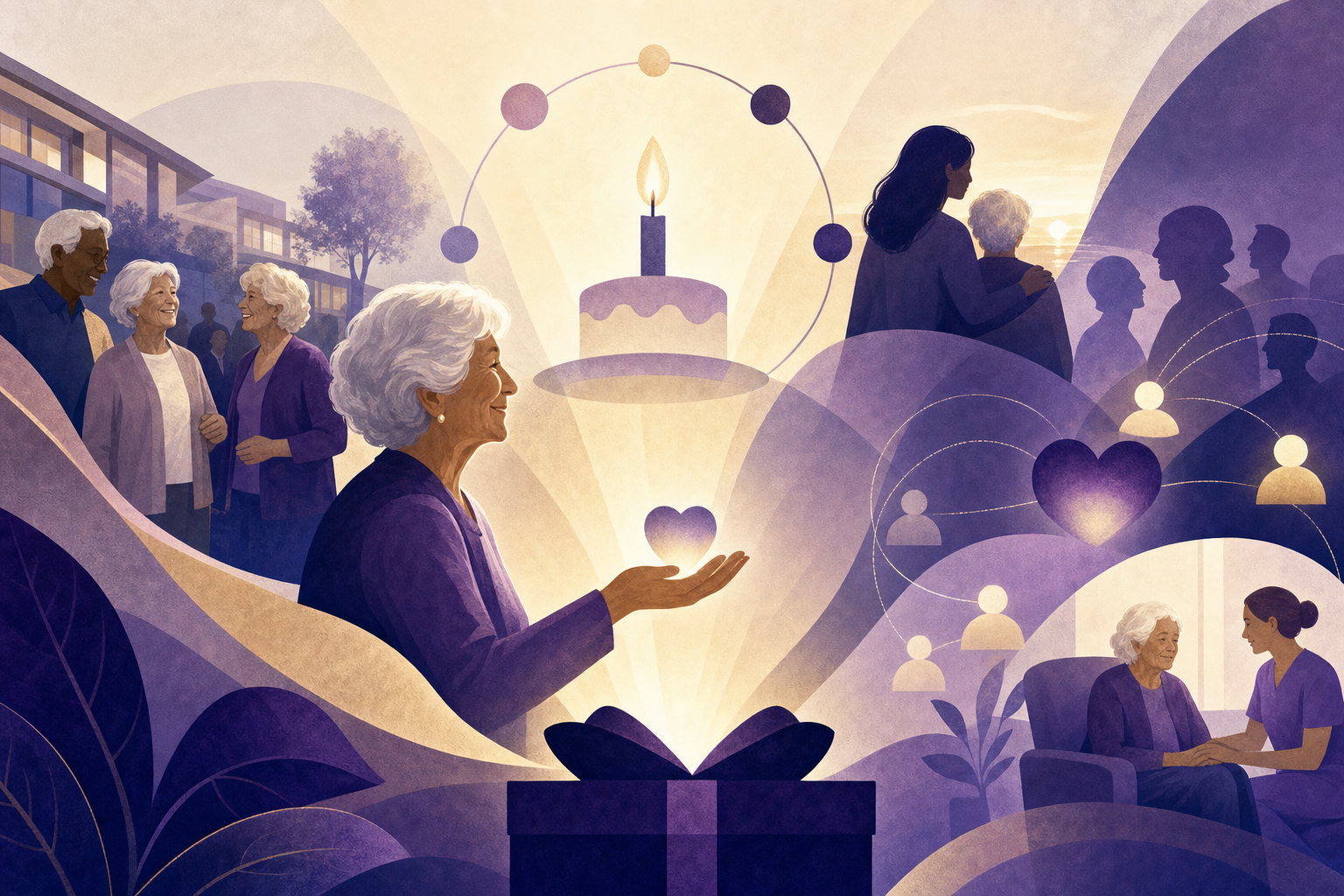
Resident-led fundraising is the simplest unlock most retirement communities never try. The development office writes the appeal letter, the activities team plans a single annual gala, and the residents themselves — the people with the deepest relational equity and the strongest personal stories — are left out of the fundraising conversation entirely. WishWell exists to fix that, by turning every resident's birthday into a small, low-effort fundraiser that compounds across the whole community.
This is the same playbook PAP Corps runs across 40 communities, raising roughly $350,000 a year — and it works because the birthday isn't a campaign. It's a moment.
Why birthdays beat the annual appeal
Retirement-community development leaders usually have three fundraising surfaces: the annual appeal letter, the gala, and the planned-giving program. All three depend on the same small group of donors saying yes one big time. Birthday-based fundraising flips the math:
Every resident has one. That gives you 12 natural fundraising moments per year per resident, not one.
The ask is from the resident, not the institution. Donors give because Helen is turning 87, not because the foundation sent a letter.
The average gift is small (about $50 per donor per year, in line with peer-to-peer fundraising benchmarks), so people say yes easily.
The donor pool grows with the resident's family and friends, not just the community's mailing list.
For a 200-resident community, even a 25% participation rate means 50 birthday fundraisers per year. At an average of 12 donors per campaign and $50 per donor, that's $30,000 in incremental revenue with no gala overhead.
What a 'resident champion' actually does
The mistake most development teams make on day one is treating birthday fundraising like a new development program with its own staff time. It isn't. It's a champion program. You need one resident per floor, neighborhood, or wing who is willing to do three small things:
Identify residents with upcoming birthdays (the activities calendar already has this).
Help that resident pick a cause inside the community foundation that means something to them — chapel repair, the scholarship fund, the dementia care wing.
Share the birthday-giving link with family and friends the resident wants invited.
That's it. The champion is not a fundraiser, a marketer, or a tech administrator. The platform handles the link, the receipts, the tax letter, and the dashboard. The WishWell champion playbook at https://onegiftfoundation.org/help walks through the first 30 days for a new community.
The four numbers to track
Resident-led fundraising falls apart when development teams measure it like a gala. Gala metrics are total raised and net revenue. Resident-led fundraising metrics are different:
Birthday participation rate (what percent of residents with a birthday this month launched a campaign)
Donors per campaign (signal of how well champions are doing the share work)
Average gift size
Repeat-donor rate across the resident's family network
If birthday participation is below 20%, the problem is almost always champion identification, not technology. The community foundation guide at https://onegiftfoundation.org/help covers how to find resident champions quickly.
What happens in year two
The compounding is the interesting part. In year one, you're recruiting champions and proving the model on a handful of birthdays. In year two, the residents who tried it once tell their neighbors, the family donors from year one are already in your CRM, and the birthday calendar runs itself. PAP Corps's $350,000-a-year figure is not a year-one number. It's the result of running the same simple model across 40 communities for several years and letting the donor relationships compound.
The development team's job in year two shifts from chasing birthdays to nurturing the donor relationships birthday giving created. Those donors then become annual-appeal donors, planned-giving prospects, and gala attendees — but they came in through a $50 birthday gift, not a cold mailing list. Read the donor stewardship guide at https://onegiftfoundation.org/help for the year-two engagement plan.
The one mistake to avoid
The single biggest cause of failed resident-led fundraising rollouts is making the development team the champion. The development team can administer the platform, train the champions, and own the data — but the moment a resident's birthday campaign is launched by a staffer instead of by the resident (or their family), the donors feel it. The give rate drops. The point of birthday giving is that it comes from the resident.
If your team is willing to identify five champions, give them 30 minutes of orientation, and let them run, you will outperform every annual appeal you've ever sent.
Learn more about How WishWell Works or Book a 15-minute WishWell demo at https://onegiftfoundation.org/ryan